

Analytics-Objekte
Bei Verwendung des Bereichs Analytics-Objekte kann der Benutzer von Design Analytics Bericht/Dashboards für Analytics-Objekte erstellen und kann die folgenden Arten von Geschäftsfragen beantworten:
- Wie viele von jedem Objekttyp hat die Institution?
- Wie viele Benutzer haben ihrem Dashboard ein Widget hinzugefügt?
- Wie viele Benutzer haben einen planmäßigen Bericht oder ein planmäßiges Dashboard abonniert?
- Namen und Standorte der einzelnen Objekttypen
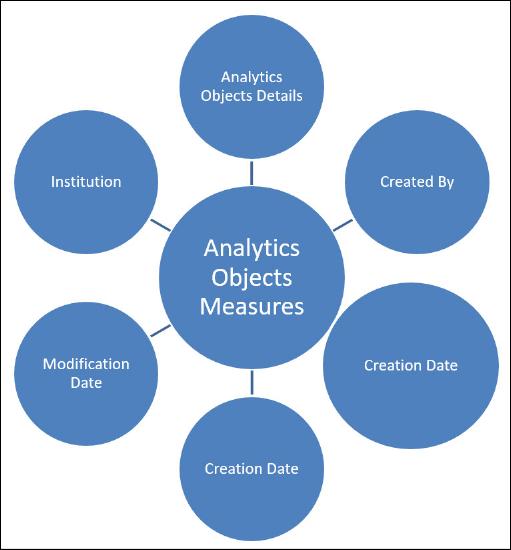
Sternendiagramm - Analytics-Objekte
Feldbeschreibungen
Im Folgenden werden die in Analytics-Objekte verfügbaren Felder aufgelistet.
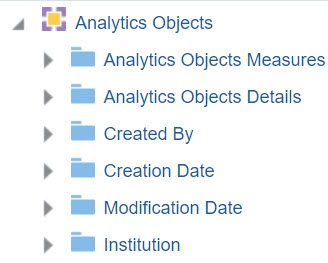
Analytics-Objekte - Feldbeschreibungen
Analytics-Objekte - Messwerte
Die Tabelle Analytics-Objekte - Messwerte ist eine Faktentabelle, in der alle Messwerte für Analytics-Objekte gespeichert werden.
| Feld | Beschreibung (Description) | Zusätzliche Informationen (Additional Information) |
|---|---|---|
| Anzahl der Objekte (Num of Objects) | Die Anzahl der Analytics-Objekte, durch die Institution erstellt wurden. | |
| Anzahl der Objekte für die Quelle Alma (Num of Objects for Source Alma) | Die Anzahl der Objekte, die Alma durch die Institution von Alma Analytics erstellt wurden. | |
| Anzahl der Objekte für die Quelle Primo (Num of Objects for Source Primo) | Die Anzahl der Objekte, die durch die Institution von Primo Analytics erstellt wurden. | |
| Anzahl der Objekte vom Typ Dashboard (Num of Objects of Type Dashboard) | Die Anzahl der Analytics-Objekte vom Typ Dashboard | |
| Anzahl der Objekte vom Typ DV | Die Anzahl der Analytics-Objekte vom Typ Daten-Visualisierung | |
| Anzahl der Objekte vom Typ Dashboard - Aktiv (abzulehnen) | Die Anzahl der aktiven Objekte vom Typ Dashboard | Dieses Feld wird in einer zukünftigen Version abgelehnt und sollte nicht verwendet werden. |
| Anzahl der Objekte vom Typ Dashboard - Nicht aktiv (abzulehnen) | Die Anzahl der nicht aktiven Objekte vom Typ Dashboard | Dieses Feld wird in einer zukünftigen Version abgelehnt und sollte nicht verwendet werden. |
| Anzahl der Objekte vom Typ Bericht (Num of Objects of Type Report) | Die Anzahl der Analytics-Objekte vom Typ Bericht | |
| Anzahl der für die Startseite markierten DV-Objekte | Die Anzahl der Analytics-Objekte vom Typ Daten-Visualisierung, die als zur Verwendung als Alma-Startseite verfügbar markiert sind. | |
| Anzahl der geplanten Objekte | Die Anzahl der geplanten Analytics-Objekte | |
| Anzahl der Objekte vom Typ Planmäßiger Bericht - Aktiv (abzulehnen) | Die Anzahl der aktiven Objekte vom Typ Planmäßiger Bericht | Dieses Feld wird in einer zukünftigen Version abgelehnt und sollte nicht verwendet werden. |
| Anzahl der Objekte vom Typ Planmäßiger Bericht - Nicht Aktiv (abzulehnen) | Die Anzahl der nicht aktiven Objekte vom Typ Planmäßiger Bericht | Dieses Feld wird in einer zukünftigen Version abgelehnt und sollte nicht verwendet werden. |
| Anzahl der als Widget hinzugefügten Objekte | Die Anzahl der Analytics-Objekte, die als Widget hinzugefügt wurden | |
| Anzahl der Benutzer-Abonnenten | Die Anzahl der Benutzer, die den Planmäßigen Bericht abonniert haben. | |
| Anzahl der angezeigten Widget-Instanzen | Die von allen Benutzern angezeigten Zahlen-Widgets | Dasselbe Widget wird für jeden Benutzer, der das Widget verwendet, separat gezählt |
| Anzahl der per Anhang gelieferten Objekte | Die Anzahl der Analytics-Objekte, die zum Senden als Anhang markiert sind | |
| Anzahl der per Link bereitgestellten Objekte | Die Anzahl der Analytics-Objekte, die zum Senden als Link markiert sind | |
| Anzahl der per FTP bereitgestellten Objekte | Die Anzahl der Analytics-Objekte, die für die Lieferung per FTP markiert sind | |
| Anzahl der Benutzer, die ein Objekt angeheftet haben | Die Anzahl der Benutzer, die ein Objekt angeheftet haben | |
| Anzahl der gemeinsamen internen Benutzer | Die Anzahl der internen Benutzer, mit denen das Analytics-Objekt geteilt wird | |
| Anzahl der gemeinsamen Benutzer nach Rolle | Die Anzahl der Rollen, mit denen das Analytics-Objekt geteilt wird |
Analytics-Objekt - Details
Die Tabelle Analytics-Objekt - Details ist eine Dimensionstabelle, in der alle Messwerte für Analytics-Objektdetails gespeichert sind.
| Feld | Beschreibung (Description) | Zusätzliche Informationen |
|---|---|---|
| Objekt-ID (Object ID) | Die Objekt-ID | |
| Objekt-Bericht-URL | Die Bericht-URL des Analytics-Objekts. | Dieses Feld unterstützt nur Alma Analytics-Objekte. |
| Objektart | Die Objektart | |
| Berichtname | Der Objektname | |
| Objekttitel (Object Title) | Der Objekttitel | |
| Objektbeschreibung (Object Description) | Die Objektbeschreibung | |
| Bericht-Standort (Report Location) | Der Bericht-Standort | |
| Planmäßiges Berichtseinreichungsformat | Das planmäßige Berichtsformat | |
| Planmäßige Häufigkeit (Scheduled Frequency) | Die planmäßige Häufigkeit | |
| Planmäßiger Status (Scheduled Status) | Der planmäßige Status | |
| Planmäßiges FTP (Scheduled FTP) | Das planmäßige FTP | |
| Quellsystem (Source System) | Das Quellsystem | |
| Themenbereich (Subject Area) | Der Themenbereich des Berichts des Analytics-Objekts | |
| Ist voreingestellt | Gibt an, ob der Bericht oder das Dashboard des Analyseobjekts „voreingestellt“ ist – erstellt von Ex Libris | |
| Ist ein Widget | Gibt an, ob das Analytics-Objekt als Widget hinzugefügt wird, das zur Alma-Startseite hinzugefügt werden kann | |
| Ist die DV-Startseite | Zeigt an, dass das Analytics-Objekt vom Typ „Datenvisualisierung“ als zur Verwendung als Alma-Homepage verfügbar markiert ist | |
| Ist planmäßig | Gibt an, ob das Analyseobjekt planmäßig ist | |
| Geplant nach Link/Anhang | Gibt an, ob das geplante Analytics-Objekt zum Senden als Link oder als Anhang markiert ist | |
| Gemeinsame interne Benutzer | Die Namen der internen Benutzer, mit denen das Analytics-Objekt geteilt wird | |
| Geteilte Rollen | Die Rollen, mit denen das Analytics-Objekt geteilt wird |
Erstellt von (Created By)
Die Tabelle Erstellt von ist eine Dimensionstabelle, in der alle Messwerte gespeichert sind, die sich auf den Ersteller von Analytics-Objekten beziehen.
Die Feldbeschreibungen finden Sie in der gemeinsamen Dimension Benutzerdetails.
- Viele Institutionen speichern Informationen über Personen, einschließlich persönlicher Daten und Informationen über ihre Aktivitäten. Aufgrund von Datenschutzanliegen müssen einige Institution die Daten regelmäßig anonymisieren.
- Alma bietet die Option, Benutzerinformationen zu Benutzung und Fernleihe zu löschen. Die Informationen werden für abgeschlossene Vorgänge wie abgeschlossene Ausleihen, abgeschlossene Gebührenaktivitäten oder abgeschlossene Fernleihbestellungen, gelöscht.
- Sie können Alma so einstellen, dass spezifische Informationen zu einer Person (z. B. Benutzername) gelöscht werden und allgemeine Benutzerinformationen (z. B. Benutzergruppe und Berufsbezeichnung) erhalten bleiben.
- Informationen, die nicht anonymisiert werden, können in Analytics-Berichte einfließen.
- Für weitere Informationen zum Thema Anonymisierung siehe Sicherheit und Datenschutz.
| Feld | Beschreibung (Description) | Zusätzliche Informationen |
|---|---|---|
| Benutzer-ID (User ID) | Speichert die eindeutige ID des Benutzers | |
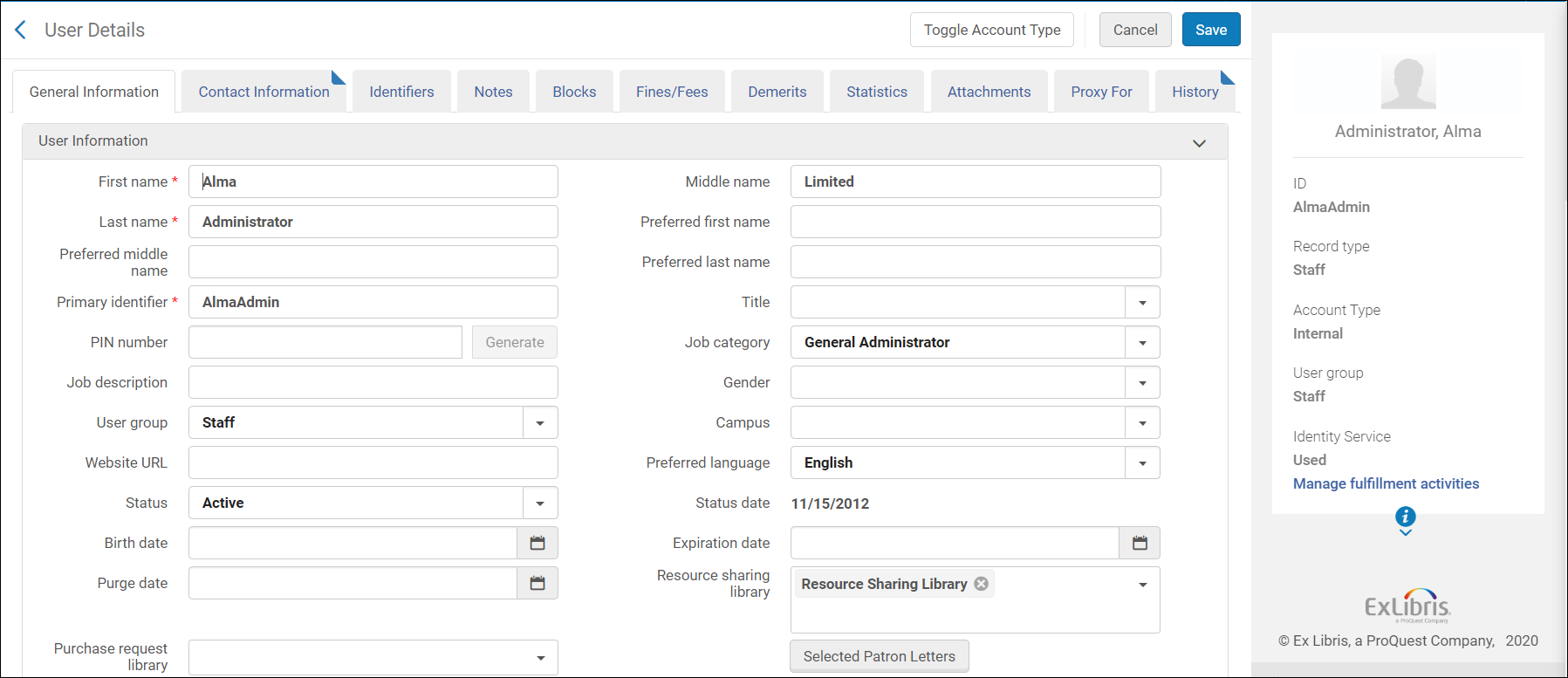
| Primäre Kennung (Primary Identifier) | Speichert die primäre Kennung, die der Benutzer verwendet, um sich bei Alma anzumelden | Position des Feldes in Alma: Siehe Abbildung unten. |
| Benutzertitel | Der Titel des Benutzers | |
| Benutzertyp (User Type) | Speichert die Werte Intern und Extern. |
Position des Feldes in Alma: Siehe Abbildung unten.
|
| Benutzergruppe (User Group) | Speichert die Gruppe, der der Benutzer zugeordnet ist, z. B. Fakultät, Absolvent oder Student | Position des Feldes in Alma: Siehe Abbildung unten. |
| Benutzersatztyp (User Record Type) | Gibt an, ob der Benutzer ein öffentlicher Benutzer oder ein Mitarbeiter ist | Position des Feldes in Alma: Siehe Abbildung unten. |
| Vorname (First Name) | Speichert den Vornamen des Benutzers | Position des Feldes in Alma: Siehe Abbildung unten. |
| Vollständiger Name (Full Name) | Vor- und Nachname des Benutzers | Es gibt keine Option, den zweiten Vornamen einzuschließen. |
| Nachname (Last Name) | Speichert den Nachnamen des Benutzers | Position des Feldes in Alma: Siehe Abbildung unten. |
| Zweiter Vorname (Middle Name) | Speichert den zweiten Vornamen des Benutzers | Position des Feldes in Alma: Siehe Abbildung unten. |
| Bevorzugter Vorname | Speichert den bevorzugten Vornamen des Benutzers | Position des Feldes in Alma: Siehe Abbildung unten. |
| Bevorzugter Nachname | Speichert den bevorzugten Nachnamen des Benutzers | Position des Feldes in Alma: Siehe Abbildung unten. |
| Bevorzugter zweiter Vorname | Speichert den bevorzugten zweiten Vornamen des Benutzers | Position des Feldes in Alma: Siehe Abbildung unten. |
| Arbeitsfeld-Beschreibung (Job Description) | Speichert Freitext, der die Funktion des Benutzers in der Bibliothek beschreibt | Position des Feldes in Alma: Siehe Abbildung unten. |
| Arbeitsfeld-Titel (Job Title) | Speichert die Definition des Arbeitsfeldes, zu der der Benutzer gehört, basierend auf der Codetabelle für Arbeitsfelder | Position des Feldes in Alma: Siehe Abbildung unten. |
| Geschlecht (Gender) | Mögliche Werte werden der Codetabelle für Geschlechter entnommen (Konfiguration > Benutzerverwaltung > Benutzerdetails > Geschlecht) | Position des Feldes in Alma: Siehe Abbildung unten. |
| Geburtsdatum (Birth Date) | Speichert das Geburtsdatum des Benutzers | Position des Feldes in Alma: Siehe Abbildung unten. |
| Campus-Code (Campus Code) | Speichert den Campus-Code des Benutzers | Position des Feldes in Alma: Siehe Abbildung unten. |
| Statusdatum (Status Date) | Speichert das Datum, an dem der Benutzer in der Institution registriert wurde | Position des Feldes in Alma: Siehe Abbildung unten. |
| Status (Status) | Gibt an, ob der Benutzer aktiv ist | Position des Feldes in Alma: Siehe Abbildung unten. |
| Erstellungsdatum (Creation Date) | Speichert das Datum, an dem der Benutzer im System erstellt wurde | Position des Feldes in Alma: Siehe Abbildung unten. |
| Datum der letzten Benutzeraktivität | Das letzte Datum, an dem ein Benutzer eine Anfrage gestellt oder ein Exemplar ausgeliehen oder zurückgegeben hat | |
| Geändert von (Modified By) | Speichert den Namen des Benutzers, der den Benutzersatz geändert hat | Position des Feldes in Alma: Siehe Abbildung unten. |
| Änderungsdatum (Modification Date) | Speichert das Änderungsdatum des Benutzersatzes | Position des Feldes in Alma: Siehe Abbildung unten. |
| Ablaufdatum (Expiry Date) | Speichert das Datum, an dem der Benutzer abläuft und keinen Service mehr vom System erhalten kann | Position des Feldes in Alma: Siehe Abbildung unten.
Das Ändern des Benutzer-Ablaufdatums ist eine Möglichkeit, die Fälligkeitsdaten zu steuern, die über das Ende eines Semesters hinausgehen und auf das Ende des Semesters gekürzt werden müssen. Für weitere Informationen siehe Wie Fälligkeitsdaten von Exemplaren auf das Ende des Semesters gelegt werden.
|
| Löschdatum (Purge Date) | Speichert das Datum, an dem der Benutzersatz von Alma gelöscht werden soll | Position des Feldes in Alma: Siehe Abbildung unten. |
| Standardsprache (Default Language) | Speichert die Standardsprache des Benutzers | Position des Feldes in Alma: Siehe Abbildung unten. |
| Autor (Creator) | Speichert den Namen des Benutzers, der den Benutzer im System erstellt hat | Position des Feldes in Alma: Siehe Abbildung unten. |
| Externe ID | Speichert die ID des Benutzers im Ursprungssystem | |
| Kennung 1 (Identifier 1) | Speichert Kennung 1. | Im Feld Kennung können Sie die Benutzerdetails, die in Analytics exportiert werden, mit zusätzlichen Kennungen anreichern. Die Auswahl einer spezifischen Kennung, die in die Benutzerdetails einbezogen werden soll, erfolgt in Alma (in einer Tabelle, deren Zugang derzeit auf Ex-Libris-Mitarbeiter beschränkt ist). Für Hilfestellung bei der Definition dieses Feldes wenden Sie sich an den Ex-Libris-Support.
Es wird nur ein Wert pro Kennung unterstützt.
|
| Kennung 2 (Identifier 2) | Speichert Kennung 2. Siehe die Details für Kennung 1 oben. | |
| Statistische Kategorien 01-10 (Statistical Categories 01-10) | In diesen Feldern können Sie zehn statistische Kategorien zuordnen. Dies ermöglicht das Filtern von Berichten, basierend auf erweiterten Benutzerinformationen, die üblicherweise in den statistischen Kategorie-Feldern gespeichert werden. Für weitere Informationen siehe Konfiguration von statistischen Kategorien für Analytics. | |
| Fernleihbibliothek-Code (Resource Sharing Library Code) | Der Code der Fernleihbibliothek, die dem Benutzer zugewiesen ist. | |
| Fernleihbibliothek (Resource Sharing Library) | Die Fernleihbibliothek, die dem Benutzer zugewiesen ist. | |
| Katalogisierer-Ebene | Die Katalogisierer-Ebene des Benutzers | |
| Hat eine andere Rolle als der Benutzer | Zeigt an, ob er Benutzer eine andere Rolle als der Benutzer innehat | |
| Hat eine andere Rolle als der Benutzer und Dozent | Zeigt an, ob er Benutzer eine andere Rolle als der Benutzer innehat | |
| Ist gesperrt | Zeigt an, ob der Benutzer gesperrt ist | |
| Benutzerbriefe – Angemeldet | Die Briefe, für die sich der Benutzer angemeldet hat | |
| Benutzerbriefe – Abgemeldet | Die Briefe, für die sich der Benutzer abgemeldet hat | |
| Benutzer – Von anderer Institution verknüpft (User – Linked From Other Institution) | Gibt an, ob der Benutzer von einer anderen Institution verknüpft wurde | Mögliche Werte:
|
| Benutzer – Von Institutionscode verlinkt User – Linked From Institution Code) | Der Code der Institution, von der der Benutzer verknüpft wurde | |
| Benutzer – Von Institutionsname verlinkt (User – Linked From Institution Name) | Der Name der Institution, von der der Benutzer verknüpft wurde | |
| Mit anderer Institution verknüpft (Linked To Other Institution) | Gibt an, ob der Benutzer in einer anderen Institution für Dienste auf Primo/Alma zugegriffen hat. Beachten Sie, dass dies nicht notwendigerweise darauf hinweist, dass die Dienste tatsächlich bereitgestellt wurden oder dass ein verknüpftes Konto erstellt wurde. | Mögliche Werte:
|
| Benutzergruppen-Code | Der Benutzergruppen-Code |


Erstellungsdatum (Creation Date)
Die Tabelle ist eine Dimensionstabelle, in der alle Messwerte zum Erstellungsdatum der Analytics-Objekte gespeichert sind.
| Feld | Beschreibung (Description) | Zusätzliche Informationen |
|---|---|---|
| Erstellungsdatum (Creation Date) | Speichert das passive Fernleihe- Erstellunggsdatum in einem Datumsformat wie z. B. 2/29/2012 | |
| Erstellung - Beginn der Woche | Das Datum des ersten Geschäftstages der Woche | |
| Erstellung - Wochennummer | Die Nummer der Woche des Jahres | |
| Erstellungsmonat - Schlüssel (Creation Month Key) | Speichert den Monat des Datums im Zahlenformat, z. B. 2 für Februar | Dieses Feld ist nützlich, wenn Sie nach Monat sortieren möchten |
| Erstellungsmonat (Creation Month) | Speichert den Monat des Datums in einem Monatsbeschreibungsformat, beispielsweise Februar | |
| Erstellung - Vollständiger Monat (Creation Full Month) | Speichert den Monat und das Jahr des Datums in einem Anzeigeformat wie z. B. Feb 12 | |
| Erstellung - Quartal (Creation Quarter) | Speichert das Quartal des Datums in einem Anzeigeformat, z. B. Q1 | |
| Erstellungsjahr (Creation Year) | Speichert das Jahr des Datums in einem String-Format wie 2012 | |
| Erstellung - Abrechnungsmonat - Schlüssel (Creation Fiscal Month Key) | Speichert das Geschäftsjahr des Datums im Zahlenformat, z. B. 2 für Februar. | |
| Erstellung - Abrechnungszeitraum (Creation Fiscal Year) | Speichert das Geschäftsjahr des Datums in einem String-Format wie 2012. | |
| Erstellungsdatum - Filter (Creation Date Filter) | Wird verwendet, um die Berichtsergebnisse nach Datum zu filtern. | |
| Erstellung Jahr-Monat | Das Jahr und Monat im Format 2023-1 | |
| Erstellungsdatum (Creation Date) | Speichert die Hierarchiespalte, in der der Benutzer einen Drilldown von Jahr zu Monat bis zu einem bestimmten Ausleihdatum durchführen kann. Wenn Sie diese Spalte verwenden, haben Sie die Möglichkeit, die akkumulierenden Kennzahlen in jeder Hierarchieebene anzuzeigen. |
Änderungsdatum (Modification Date)
Die Tabelle ist eine Dimensionstabelle, in der alle Messwerte zum Änderungsdatum von Analytics-Objekten gespeichert sind.
| Feld | Beschreibung (Description) | Zusätzliche Informationen |
|---|---|---|
| Änderungsdatum (Modification Date) | Speichert das Änderungsdatum im Datumsformat 2/29/2012 | |
| Änderung - Beginn der Woche | Das Datum des ersten Geschäftstages der Woche | |
| Änderung - Wochennummer | Die Nummer der Woche des Jahres | |
| Änderungsmonat-Schlüssel | Speichert den Monat des Datums im Zahlenformat, z. B. 2 für Februar | Dieses Feld ist nützlich, wenn Sie nach Monat sortieren möchten |
| Änderungsmonat | Speichert den Monat des Datums in einem Monatsbeschreibungsformat, beispielsweise Februar | |
| Änderung - Kompletter Monat | Speichert den Monat und das Jahr des Datums in einem Anzeigeformat wie z. B. Feb 12 | |
| Änderungsquartal | Speichert das Quartal des Datums in einem Anzeigeformat wie Q1 | |
| Änderungsjahr | Speichert das Jahr des Datums in einem String-Format wie 2012 | |
| Änderung - Abrechnungsmonat-Schlüssel | Speichert das Geschäftsjahr des Datums im Zahlenformat, z. B. 2 für Februar. | |
| Änderung - Abrechnungsjahr | Speichert das Jahr des Datums in einem String-Format wie 2012 | |
| Änderungsdatum - Filter | Wird verwendet, um die Berichtsergebnisse nach Datum zu filtern. | |
| Änderungsjahr/-monat (Modification Year-Month) | Das Jahr und Monat im Format 2023-1 | |
| Änderungsdatum (Modification Date) | Speichert die Hierarchiespalte, in der der Benutzer einen Drilldown von Jahr zu Monat bis zu einem bestimmten Ausleihdatum durchführen kann. Wenn Sie diese Spalte verwenden, haben Sie die Möglichkeit, die akkumulierenden Kennzahlen in jeder Hierarchieebene anzuzeigen. |
Institution (Institution)