

Summon: Glanceability Feature
Introduction
CDI secondary content types provide specific information about the type of record. They do not replace but add value to the record's primary content types. Their purpose is to display additional information about the record/item in the brief display and Quick Look, and to allow filter/search on these secondary types as part of Secondary Content Type facet. The secondary content types may be one of the following types:
-
Regular – These types display as indicators in the brief display of a record in the search results and Quick Look.
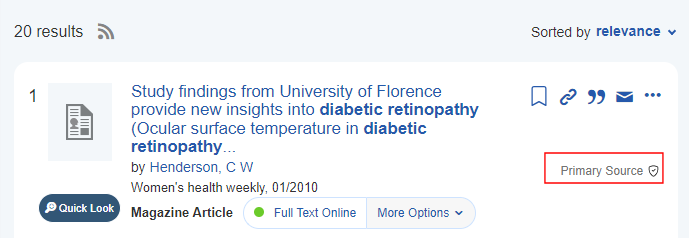 Brief Display in Search Results - Regular Type Message
-
Warning – These types display above the brief display of a record in the search results and Quick Look. They are used to warn users of a potential issue with a document in their search. Users can display additional information by selecting or hovering over the message. In the following example, the record displays two warnings:
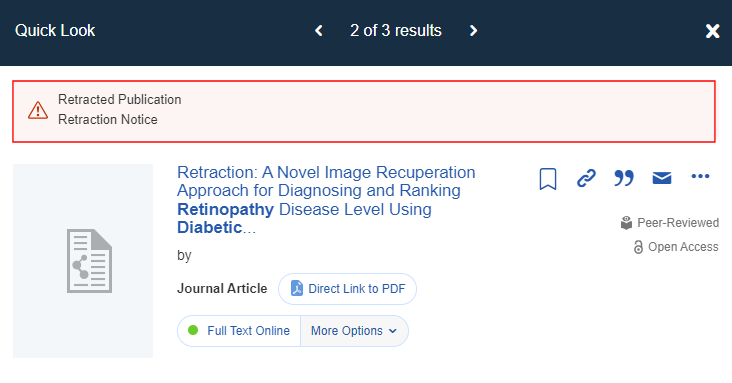 Quick Look - Warning Type Message
While in some cases the secondary content types can be taken directly from a field in the source data, but in other cases we use words or phrases from the title or other metadata fields to identify them. Not all items in CDI can be associated with their secondary types, but since we continuously update our content, newly flagged items will appear over time.
The following table lists the currently supported secondary content types in CDI:
| Secondary Content Type | Type | Definition |
|---|---|---|
|
Review Article |
Regular |
An article that provides analysis, review or interpretation of a body of primary research on a specific topic. Presents a current state of the research on a particular topic or research area. |
|
Primary Source |
Regular |
The primary sources provide first-hand testimony or direct evidence concerning a topic under investigation. They contain the actual textual material that is the subject of research. The Library of Congress refers to them as the "raw materials of history — original documents and objects which were created at the time under study." |
|
Preprint |
Regular |
A preprint is a preliminary version of a scientific manuscripts that researchers share by posting to online platforms known as preprint servers before peer-review and publication in an academic journal. Preprints are typically published in Preprint servers, publicly available online archives that host preprints and their associated data. |
|
Retracted Publication |
Warning |
A retraction is the action by which a published paper in an academic journal is removed from the journal because the publication contains such seriously flawed or erroneous data that its findings and conclusions cannot be relied upon. Unreliable data may result from honest error or from research misconduct. Datasets can also be retracted. The original article may and in most cases have a different date from the retraction notice. |
|
Retraction Notice |
Warning |
A retraction notice typically accompanies the retraction of a scientific publication. It is a short article written by the editors or authors explaining the reason for a retraction. |
|
Publication with Addendum |
Warning |
A publication that contains an addendum, a notification of an addition of information to an article. |
|
Publication with Corrigendum |
Warning |
A publication with a correction notice or corrigendum, a change to the article that the author wishes to publish at any time after the article acceptance or publication, usually to correct an error. |
Configuration Options
This features is disabled by default. If you would like to enable this feature, set the Secondary Content Type option to ON under Settings > Search Results in the Summon Administration Console. For more information, see Search Results.
If you want to filter search results by these attributes, enable the Secondary Content Type facet. For additional information, see Administration Console Settings - Refine Your Search.
CDI Secondary Content Type Sources
The following table lists the currently supported secondary content types in CDI:
| Secondary Content Type | Sources |
|---|---|
|
Review Article |
All records where XML field in the source data indicates the record is a review article. Sources: ACM, BMJ, CABI, Elsevier, Proquest, Pubmed, Springer |
|
Primary Source |
All records from the following collections:
|
|
Preprint |
All records from ArXiv source where there is no DOI, or the DOI present in the record has the ArXiv prefix (10.48550/ ). If there is a DOI that does not equal the Arxiv prefix (10.48550/ ) in the ArXiv data – this means it has been published elsewhere and a published version is now available. In this case we will no longer assign the attribute Preprint. |
|
Retracted Publication / Retraction Notice |
All records where XML field in the source data indicates the record is a review article. All records where no retraction information is available in the merged record from CrossRef or Pubmed, but where the title of the record includes an indication that the article is retracted, or that the article itself is a retraction notice. Sources: BMJ, Elsevier, Proquest, Scopus, Springer |
|
Publication with Addendum |
All records where XML field in the source data indicates the record is a publication with addendum. Sources: BMJ, Elsevier |
|
Publication with Corrigendum |
All records where XML field in the source data indicates the record is a publication with corrigendum. Sources: BMJ, Elsevier |